ProKPO Research · Nursing Care Intelligence

Better care starts with
clearer evidence.

Helping nurses see what changed, where it came from, and what needs a second look.

See how it could work
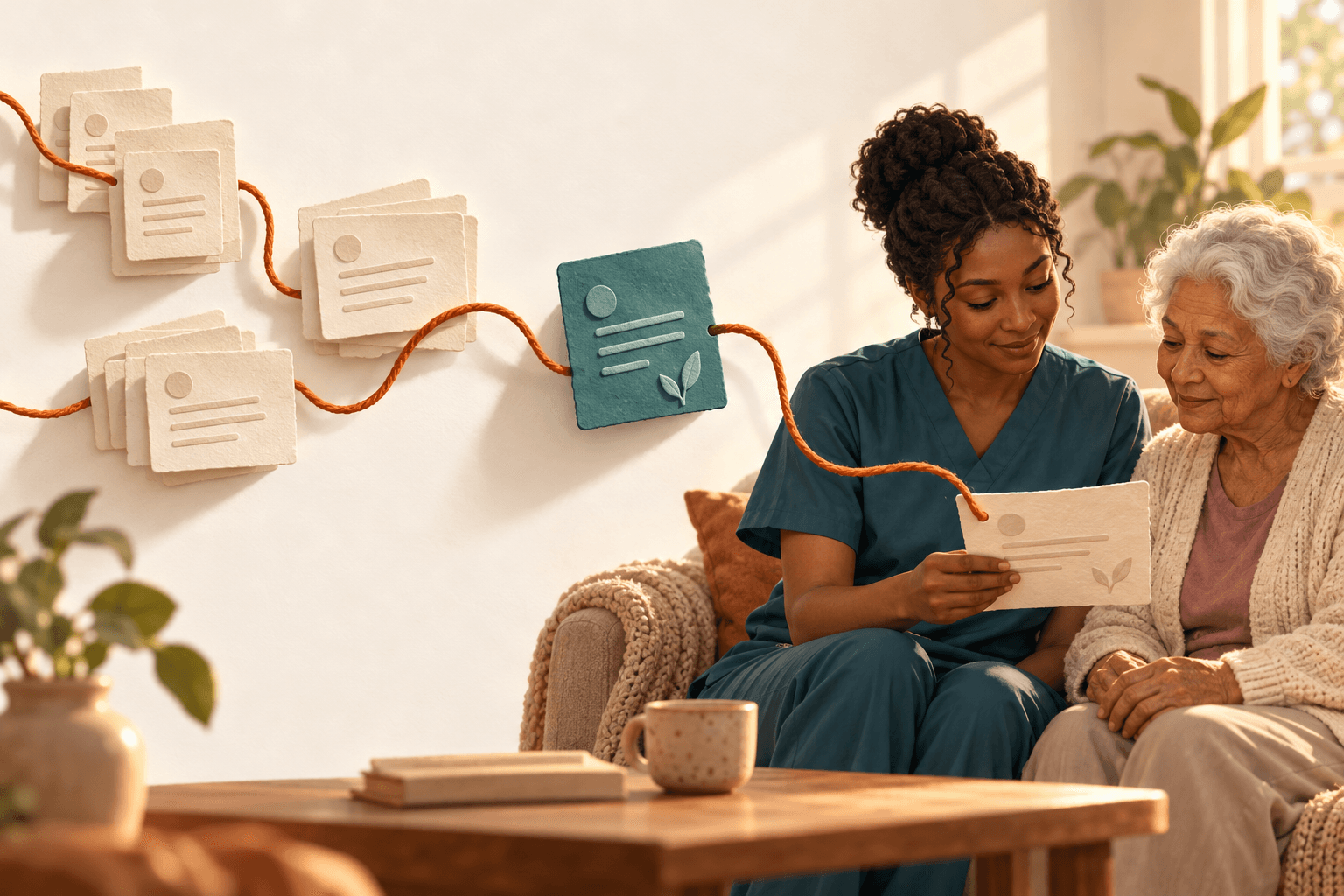
An orange thread connects repeated notes and a new observation to a nurse reviewing a care plan with an older adult.
Trace the source.Notice the change.Keep the nurse in control.
An illustration of our research vision
Research in development

T-CERA and LEOTI are proposed innovations. Technical performance and clinical effectiveness have not yet been validated.

The question behind our research

If a note appears four times,
is it four pieces of evidence?

Perhaps. Or perhaps it was copied.
The difference matters when care needs change.

Try the idea · 30 seconds

Follow the evidence.

Fictional example · illustrative concept
Earlier care planDay 1

“One-person assistance for transfers.”

Day 2Same instruction
Day 3Same instruction
Day 4Same instruction
Day 5Same instruction
4 repeated notes
New observationDay 6

“More help appeared necessary during today’s transfer.”

A different source to examine
Qualified nurse

Clinical decisions stay here.

No automatic change to the care plan.

01 / 04

Five notes. How much new evidence?

Four notes repeat an older instruction. One records a newer observation.

This guided illustration is not a live clinical analysis or a validated demonstration of T-CERA or LEOTI.

The proposed technology

From more information
to a clearer picture.

Evidence origin

Where did it start?

Trace observations to their possible source.

Meaningful change

What has changed?

Compare care needs across time.

Human oversight

What needs review?

Surface conflicts and gaps for the nurse.

T-CERAThe proposed reasoning framework+

Temporal Clinical Evidence Reconciliation and Arbitration. Our proposed framework for connecting evidence, identifying conflicts and supporting source-linked care-plan drafts.

LEOTIInvestigating evidence origin over time+

Latent Evidence-Origin Temporal Inference. A proposed method for investigating whether repeated records share an earlier source, and how new observations may signal changing care needs.

A clear line between product and research

Building the next layer.
Testing every assumption.

Our research builds on care-plan workflows already available in ProKPO.

Available today

Upload. Extract. Review.

PDF care plans and editable reminder extraction, reviewed by agency staff.

Research in development

Trace. Compare. Reconcile.

T-CERA and LEOTI: investigating evidence origin, changes and uncertainty.

Planned evaluation

Measure what matters.

Source-tracing accuracy. Change detection. Nurse review time.

A working foundation. A larger possibility.

From the care plan
to the everyday care journey.

ProKPO already brings care-plan uploads, reviewed reminders, scheduling and visit records into connected agency workflows. That foundation gives this research a practical destination: the decisions people make around everyday care.

01

Bring the plan in

Upload a PDF and keep the original.

02

Make it usable

Review extracted instructions and reminders.

03

Connect the work

Assign care plans to shifts and coordinate visits.

These product capabilities are available today. They do not yet establish evidence-origin reasoning or clinical effectiveness.

What the next chapter requires

Moving from a promising idea
to evidence people can trust.

The next step is sustained research: carefully prepared records, stronger methods and evaluation with qualified nursing professionals. Progress depends on the quality of that work—not just on generating more text.

01Understand real documentationHandwriting. Repeated notes. Incomplete timelines.+

Prepare appropriately authorised, privacy-protected research records. Build reference examples that distinguish original observations, copied instructions and information that cannot be resolved. The aim is to test the difficult cases, not only clean examples.

02Develop and challenge the methodsCan an explanation be traced back to its evidence?+

Investigate T-CERA and LEOTI against clearly defined comparison methods. Evaluate source attribution, duplicate recognition and change detection, including cases where the correct response is uncertainty. Measure errors and failure modes as carefully as successful outputs.

03Evaluate with nursing professionalsUseful in practice. Accountable to the people reviewing it.+

Design nurse-led assessments and carefully scoped pilot studies with appropriate oversight. Examine whether source-linked drafts help reviewers identify conflicts, verify recommendations and complete their work. Review time, usability and safety-related errors would be evaluation measures, not assumed benefits.

04Make the results useful beyond the labAccessible tools for the realities of home care.+

Improve document handling, readable explanations and integration with daily agency workflows. Explore how teams with different levels of technical experience can review evidence, correct mistakes and retain control. Wider use should follow appropriate evaluation, rather than precede it.

Research partnerships can help create the time, expertise and evaluation capacity this next stage needs.

The human purpose

More attention to the person.
Less time lost in the paperwork.

If validated, this work could help care teams spend less effort untangling records and more attention understanding the person behind them.

For people receiving care

Changing needs deserve to be noticed.

The goal is to help teams recognise when a person may need reassessment, while respecting their individual circumstances and dignity.

For nurses & caregivers

Clearer context. Human judgement.

Traceable information could make it easier to understand an instruction, question a conflict and bring the right concern to the nurse.

For families & communities

Care that is easier to understand.

Better-connected information could support more consistent communication and help home-care teams focus on the people who depend on them.

These are intended benefits to investigate. No improvement in patient outcomes or clinical safety has yet been demonstrated for T-CERA or LEOTI.

For research partners & funding organisations

Help turn the right questions
into better evidence.

We welcome conversations with nursing teams,
research institutions and grant partners.

Discuss a research partnershiphello@prokpo.ai